The 20-Day Interview Pattern Drill
The AlgoHay drill for coding interviews: read the constraints, name the pattern, and state the complexity out loud, twenty times
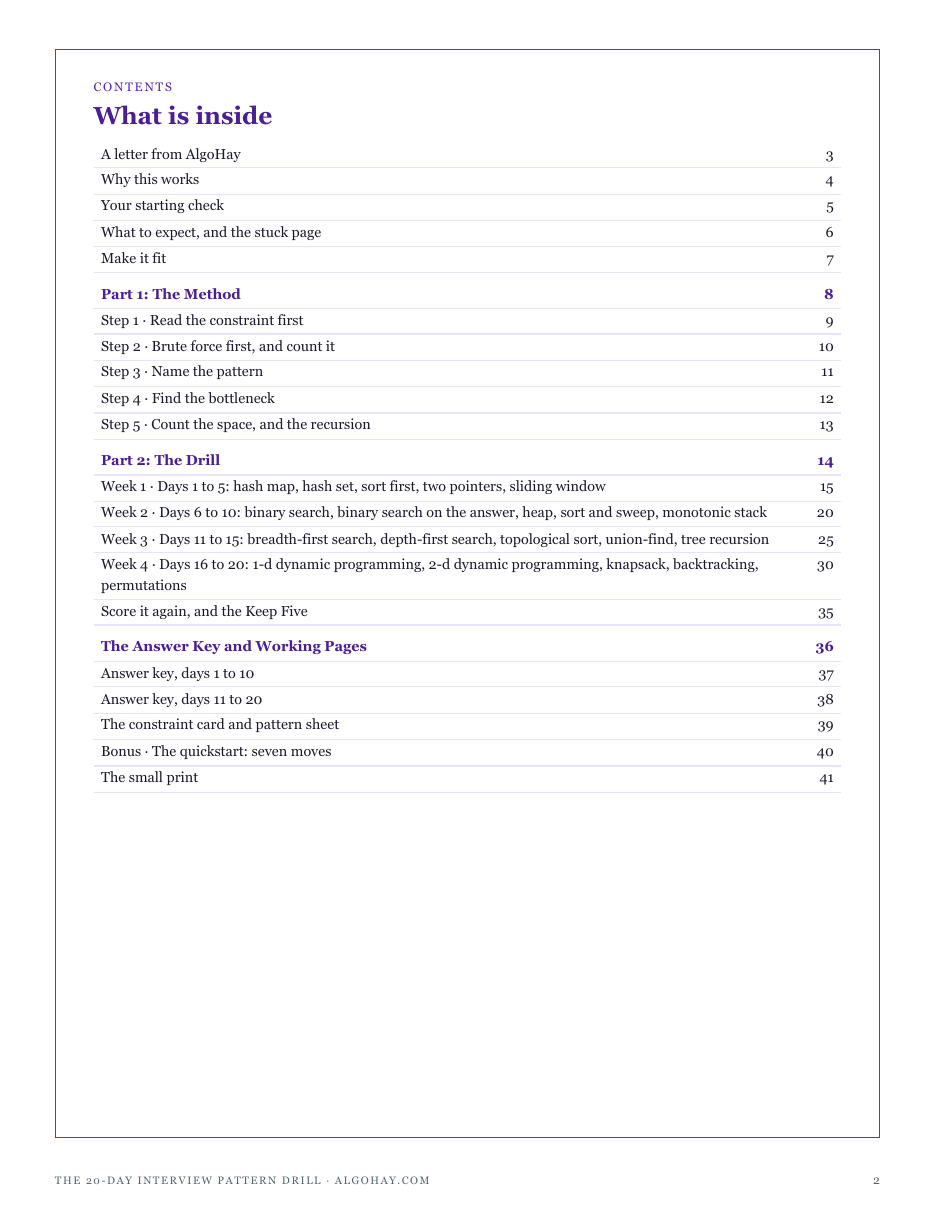
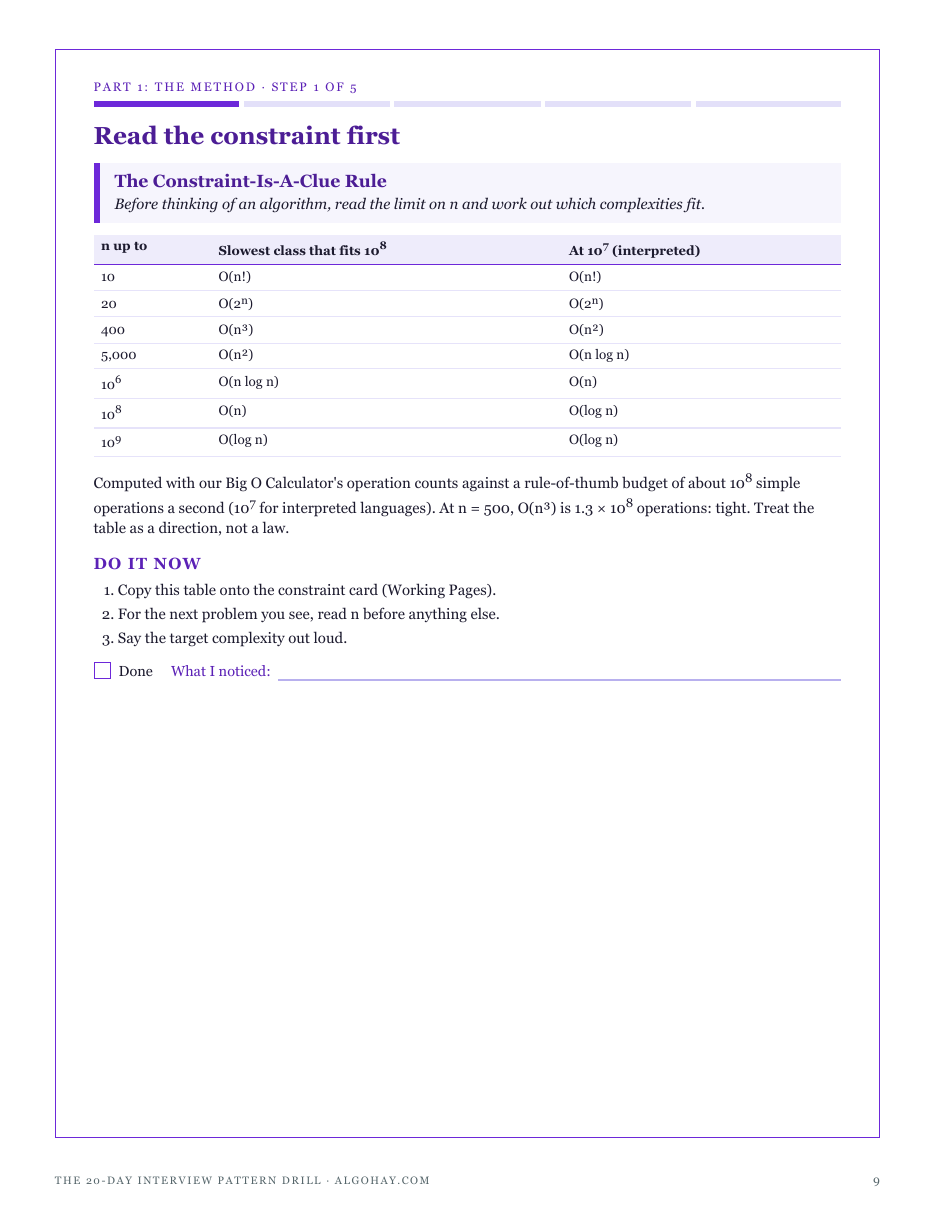
The Big O Calculator on this site tells you how many operations a growth class means at a given n. In an interview the question runs the other way: here is n and a time limit, so what complexity must the answer have? The 20-Day Interview Pattern Drill starts there. Part 1 is a five-step method to say out loud: read the constraint (a table of which complexity fits each input size, for compiled and interpreted languages), state the brute force and its count, name the pattern, find the bottleneck, count the space and recursion depth. Part 2 is twenty original problems over four weeks (arrays and hashing, search and ordering, graphs and trees, dynamic programming and search spaces), each with a worksheet and a hint. The answer key gives each approach in one line. Any language. No interview outcome is promised. With your purchase comes a personalised sheet showing what fits at your input size and where your chosen techniques are drilled.
Look inside
Two full pages from the drill, exactly as printed. Click either to read it at full size before you decide.
What is in it
- Read the constraint: which complexity fits each n
- Brute force first, and count it
- Name the pattern
- Find the bottleneck
- Count the space and the recursion
- Twenty original problems over four weeks
- A worksheet and a hint for every problem
- A one-line answer key
- A constraint card, pattern sheet and quickstart
- A personalised sheet: what fits your n, where your techniques are drilled
- ✓ 41 printable pages
- ✓ 10 sections, worksheets and templates
- ✓ A second PDF worked out from the numbers you enter
- ✓ No account needed, just an email address
- ✓ Instant download; link valid 7 days
Price includes any taxes. Sold by GrabURL, who handle checkout and support. The charge appears on your statement as GrabURL.
The drill complements the free Big O Calculator. It counts operations for a size; the drill turns a problem's constraint into the complexity it wants, and practices the patterns that reach it.